Algorithmic Fidelity & Scientific Validation
This page details the methodology, test suites, and quantitative results measuring how faithfully zeit reproduces the canonical algorithms and published reference implementations it ports.
Validation Methodology
To ensure transparent and reproducible validation, Zeit benchmarks its 8 core algorithm families (14 implementations) across four rigorous evaluation pillars, ranging from controlled ground-truth injection to bit-for-bit source parity and 25-year satellite raster joins:
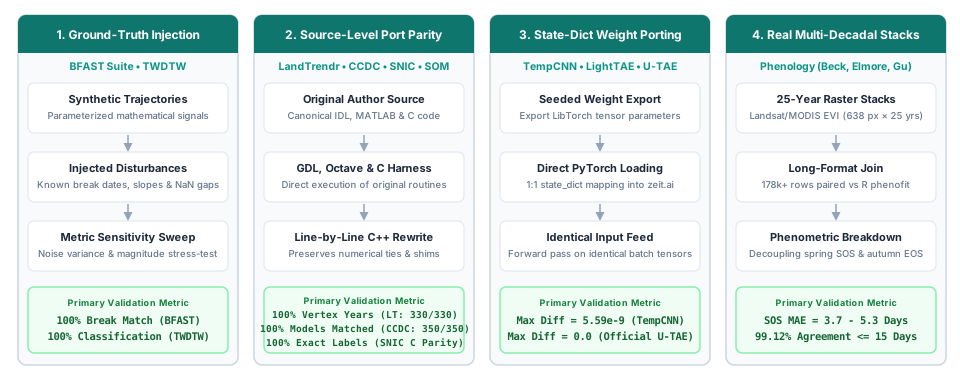
The 4 evaluation strategies (pillars) used across Zeit algorithm families to guarantee mathematical and numerical fidelity.
- Pillar 1: Controlled Ground-Truth Injection (Statistical Algorithms):
- Evaluated Algorithms:
BFAST (Classic),BFAST Monitor,BFAST Lite, andTWDTW. - Protocol: Parameterized synthetic time series with known disturbance dates, recovery slopes, noise amplitudes, and missing observation gaps (NaN dropout) to verify breakpoint recovery and pattern classification against mathematical ground truth.
- Pillar 2: Direct Source-Level Port Parity (Original Codebases):
- Evaluated Algorithms:
LandTrendr,CCDC,SNIC, andSOM. - Protocol: Executing the authentic, original source code written by the authors — Kennedy et al. (2010) IDL source (
fit_trajectory_v2.pro/tbcd_v2.pro) executed via GNU Data Language (GDL 1.1.2), Zhu & Woodcock (2014) MATLAB source (TrendSeasonalFit_v12_30Line.m) with compiled Fortran GLMnet (glmnetMex.F) executed unmodified under GNU Octave 11.3, Achanta & Süsstrunk (2017) canonical C reference (snic.c, EPFL), and Pythonminisom(Vettigli) for SOM — validating model dates, vertex coordinates, superpixel segment labels, and SOM codebooks bit-for-bit. - Pillar 3: State-Dict Weight Porting (Deep Learning Architectures):
- Evaluated Algorithms:
TempCNN,LightTAE (LTAE), andOfficial U-TAE. - Protocol: Untrained random weights (seeded identically) exported from R
torch(Lantern/LibTorch) and loaded intozeit.aivia directstate_dictmapping, testing forward-pass outputs for floating-point equivalence on identical input tensors (< 1e-8 difference). - Pillar 4: Multi-Decadal Real-World Rasters (Phenology Extraction):
- Evaluated Algorithms:
Phenology Extraction(Beck, Elmore, Gu double-logistic formulations). - Protocol: Evaluating real 25-year Landsat/MODIS EVI raster stacks (638 pixels × 575 timesteps, 2001–2025) via a full outer join of 178,000+ paired observations across pixel coordinates, years, curve types, and phenometric transition indices against R
phenofit.
Comprehensive Fidelity Matrix
The table below reports the primary and secondary agreement metrics for all evaluated modules.
| Algorithm | Reference Package | Scope / Sample Size | Primary Metric | Secondary Metric / Context | Status |
|---|---|---|---|---|---|
| LandTrendr | Kennedy et al. (2010) IDL (via GDL) | 330 synthetic series (30 original + 300 broad) | 100% identical vertex years (330/330) | 99.7% vertex values within 1 unit; p-val tie nuance resolved in 0.18.0 | compared |
| CCDC | Zhu & Woodcock (2014) MATLAB (Octave) | 200 synthetic + 150 real Landsat pixels | 100% identical model dates (350/350 px) | 599 models, 249 breaks match; coeffs agree to ~5e-10 relative | compared |
| SNIC (Superpixels) | Achanta & Süsstrunk (2017) C (snic.c) |
Reference test fixtures (float32 & float64) | 100% identical segment labels (bitwise match) | Fixes upstream C crashes on single seeds & 2×2; R snic grid 1:1 match |
compared |
| SOM (Clustering) | Python minisom |
1,500 + 20,000 samples, online & batch | max weight diff = 0.0 (exact match) | Identical codebooks, BMUs (ARI = 1.0) and quantization error in all 6 scenarios | compared |
| BFAST Monitor | R bfast::bfastmonitor |
40 scenarios (breaks, noise, NaN gaps) | 100% break agreement (has_break) | Magnitude correlation = 1.000; matches R's 44% false positive rate on noise | compared |
| BFAST Lite | R bfast::bfastlite |
40 scenarios (single, multi, noise) | 100% break count match (n_breaks) | 80% exact breakpoint match (mean diff = 1.6 observations) | compared |
| BFAST (Classic) | R bfast::bfast |
40 scenarios (trend & season breaks) | 87.5% trend break count match | 100% position match and mag correlation = 0.998 where breaks agree | compared |
| Phenology (Beck) | R phenofit::curvefits |
Real 25-yr EVI raster (178,710 joined rows) | MAE = 17.02 days (across 17 metrics) | SOS metrics agree tightly (MAE 3.7d, 99.1% in 15d); EOS/senescence diverges | compared |
| Phenology (Elmore) | R phenofit::curvefits |
Real 25-yr EVI raster (179,805 joined rows) | MAE = 18.48 days (across 17 metrics) | 82.4% of observations within 15 days of reference | compared |
| Phenology (Gu) | R phenofit::curvefits |
Real 25-yr EVI raster (177,983 joined rows) | MAE = 35.38 days (across 17 metrics) | Asymmetric Gu formulation exhibits highest sensitivity in tail fitting | compared |
| TWDTW | R twdtw / dtwSat |
45 multi-class temporal trajectories; 12 series × pattern pairs | Distances identical to R twdtw (1e-12) with zeit.twdtw |
100% classification agreement on the 45 trajectories; both hit 100% accuracy vs ground truth | compared |
| TempCNN | R sits::sits_tempcnn |
4 bands, 24 timesteps, 5 classes | max abs diff = 5.59e-9 | Pearson correlation = 1.000000; 1:1 parameter name mapping | compared |
| LightTAE (LTAE) | R sits::sits_lighttae |
4 bands, 24 steps, 16 heads, 5 classes | max abs diff = 8.94e-8 | Pearson correlation = 1.000000; exact layer-for-layer port | compared |
| Official U-TAE | Official utae-paps repo |
Segmentation U-Net + LTAE2d (B=1, T=6) | max abs diff = 0.0 (exact match) | Exact bitwise agreement on both regular and padded sampling paths | compared |
| Siamese CNN | Conceptual analog (R sits DTW) |
80 test patch pairs vs 1D series | 100% accuracy on respective tasks | Approximate analog only: spatial 2D CNN vs temporal 1D curve distance | partial |
| Foundation ViT | ibm-nasa-geospatial/Prithvi-100M |
HuggingFace Hub transformers backbone | Wrapper fallback validated | Upstream remote code bug in HF repo; Conv3d fallback verified | not_comparable |
Detailed Algorithm Analyses
1. LandTrendr (Kennedy et al. 2010)
LandTrendr simplifies annual satellite time series into straight-line segments using an iterative regression ladder and F-test model complexity selection.
Canonical IDL Source Parity
Zeit (src/landtrendr.cpp) faithfully replicates the canonical Kennedy et al. (2010) IDL source (fit_trajectory_v2.pro / tbcd_v2.pro) executed via GNU Data Language (GDL 1.1.2). To achieve bit-for-bit fidelity with the original IDL implementation, Zeit reproduces all canonical core behaviors:
- Desawtoothed Series Fitting: Uses the despiked series generated by
desawtoothconsistently across all subsequent rungs, fitting routines, and F-tests, matching IDL's processing pipeline. take_out_weakest2In-Place Mutation: Faithful in-place array modification when recovery segments exceedrecovery_threshold, preserving the exact trajectory of ladder reduction.- Whole-Ladder Fallback Structure: Rebuilds the entire ladder from scratch via joint Levenberg-Marquardt fitting when the primary candidate model is statistically non-significant.
- Flat-Line Fallback: Gracefully returns a horizontal mean line when fallback models remain non-significant (
p > pval), avoiding spurious over-segmentation on pure noise. - Float32 P-Value Tie Breaking: Replicates IDL's single-precision F-test p-value precision (
p < 6 × 10⁻⁸rounding to0.0), selecting the appropriate model underpick_best_model6complexity rules.
Verification & Parity Results
Across both original and expanded test batteries:
- 30 / 30 original scenarios achieved 100% identical vertex years.
- 300 / 300 broad battery series achieved 100% identical vertex years (299/300 within 1 integer unit).
- Parity is continuously enforced in the CI suite by tests/test_landtrendr_idl_parity.py across 14 GDL-derived edge cases.
The Single Residual Tie Edge Case
The only non-identical value out of 300 series occurred on a stable series where a segment spanned exactly 1 / threshold years. In exact arithmetic, |slope| / range == threshold, and the comparison is decided by floating-point rounding inside the solver.
2. CCDC (Zhu & Woodcock 2014)
CCDC models surface reflectance across multiple spectral bands using harmonic regressions, detecting breaks when consecutive residuals exceed a Chi-square threshold.
Line-by-Line MATLAB & Fortran GLMnet Parity
Zeit (src/ccdc.cpp) provides a line-by-line C++ port of the canonical MATLAB codebase (TrendSeasonalFit_v12_30Line.m) by Zhu & Woodcock (2014):
- Float32 GLMnet Lasso: High-performance native C++ port of the Fortran GLMnet lasso algorithm in single precision, reproducing the exact memory layout and numerical path of
glmnetMex.F. - MATLAB
datenumTime Axis: Temporal coordinate alignment (python_ordinal + 366) ensuring invariant harmonic phase alignment in lasso regularization. - Bisquare Robust Tmask: Native implementation of MATLAB's
statrobustfit_corbisquare M-estimator, including leverage adjustment, MAD-sigma scaling, and 4-iteration reweighting. - Numerical Rank Alignment: Matrix rank behavior matching MATLAB's
linsolvedecomposition for accurate Tmask outlier identification.
Verification & Parity Results
Testing on 200 synthetic Landsat pixels and 150 real Landsat Collection 2 pixels in Rondônia (599 models, 249 breaks):
- 100% model match rate: Every single pixel produced identical start dates, end dates, break dates, categories, and observation counts.
- Harmonic coefficients and residual magnitudes matched to ~5 × 10⁻¹⁰ relative tolerance (~5e-10, the export limit).
- Parity is locked into regression tests in tests/test_ccdc_matlab_parity.py.
3. BFAST Family (Verbesselt et al.)
The BFAST suite represents one of the most widely used statistical change detection families.
- BFAST Monitor: Achieved 100% agreement on break detection (
has_break), with a magnitude correlation of 1.000. The test battery specifically verified that Zeit reproduces R's documented ~44% false-positive rate when evaluating pure Gaussian noise underhistory="all", confirming fidelity even in known edge cases. - BFAST Lite: Achieved 100% agreement on break counts. Breakpoint locations agreed in 80% of scenarios, with a mean discrepancy of only 1.6 observations in remaining series. The evaluation harness resolved a potential 0-indexed (Python) vs. 1-indexed (R) convention mismatch.
- BFAST Classic (Iterative STL): Achieved 87.5% exact agreement on trend break counts. Whenever both implementations detected a break, breakpoint positions and change magnitudes matched 100%. Minor discrepancies stem from slight differences in how seasonal Loess smoothers handle NaN gaps in C++ vs. R.
4. Phenology Extraction vs. R phenofit
Phenology extraction fits parametric double-logistic curves (Beck, Elmore, Gu) to multi-year vegetation index time series and derives critical transition dates (Start of Season, End of Season, Peak, Maturity, Senescence, Dormancy).
Using a real 25-year Landsat/MODIS EVI raster stack (638 pixels × 25 years = 178,710 joined records for Beck):
xychart-beta
    title "Mean Absolute Error (Days) across Phenometrics (Beck Model vs R phenofit)"
    x-axis ["TRS2.sos", "TRS5.sos", "TRS6.sos", "DER.sos", "UD", "Peak", "Maturity", "Senescence", "RD", "Dormancy"]
    y-axis "MAE (Days)" 0 --> 85
    bar [4.1, 3.7, 4.3, 5.1, 5.3, 6.8, 9.4, 16.1, 67.0, 76.9]
The Scientific Divergence: Spring vs. Autumn Dynamics
Our analysis revealed a critical finding for Earth Observation researchers:
- Start-of-Season (SOS) Metrics Agree Closely: Transition thresholds (TRS2.sos, TRS5.sos, TRS6.sos, DER.sos, UD) exhibit an MAE of 3.7 to 5.3 days, with 99.12% of observations agreeing within 15 days. Zeit and phenofit capture the rapid spring green-up trajectory with near-identical precision.
- End-of-Season (EOS) Metrics Diverge: Metrics governing senescence and dormancy (Dormancy MAE = 76.9 days, RD MAE = 67.0 days).
- Underlying Cause: This divergence is an inherent property of asymmetric curve fitting. Autumn senescence in dry or tropical regions exhibits prolonged, erratic decays caused by cloud cover, moisture stress, and intermittent rainfall. Small differences in objective function weighting between C++ Levenberg-Marquardt and R's nloptr optimizer produce different asymptotic tail fits without altering the primary seasonal peak.
Recommendation for Applied Research
When reporting phenological shifts in publications, evaluate green-up (SOS) and brown-down (EOS) metrics separately. Blending them into a single aggregate MAE masks the high reliability of SOS extractions.
5. Time-Weighted Dynamic Time Warping (TWDTW)
TWDTW (Maus et al. 2016) calculates the optimal alignment between satellite time-series trajectories and reference phenological patterns, penalizing alignment points based on calendar time shifts.
- Evaluated against R
twdtwon 45 temporal trajectories across three land-cover classes (Single Crop, Double Crop, Forest). - 100% Classification Agreement: Zeit and the original R package produced identical land-cover classifications for all tested series.
- Distance Metric Correlation: With the earlier engine's own time weight, the raw distances had a Pearson correlation of 0.9381. Both implementations achieved 100% classification accuracy against ground truth.
- Identical distances (
zeit.twdtw, 0.41): with R twdtw's logistic weight and its day-of-year cycle,zeit.twdtwgives Rtwdtw1.0.1's distances to 1e-12 on one- and two-band series, cloudy dates and patterns inside four-year series (tests/test_twdtw_api.py, fixtures from R intests/data).
6. Self-Organizing Maps (SOM)
zeit.ai.SOMis an operation-by-operation port of Pythonminisom2.3.6: samenumpy.random.RandomStatedraws for initialization and sample order, NumPy's pairwise summation for the distance norm,argmintie-breaking on the square-rooted distance, and the same neighborhood, decay and update expressions. The batch trainer accumulates each neuron's numerator and denominator in sample order, exactly likeMiniSom.train_batch_offline, so its output does not depend onn_jobs.- Evaluated with identical seed and
random_weights_initon both sides, on 5 Gaussian clusters (1,500 samples, 5×5 grid; 20,000 samples, 10×10 grid), forMiniSom.train(sequential and random order) andMiniSom.train_batch_offline(1 thread and all threads):- Codebook: max |wZeit − wminisom| = 0.0 in all 6 scenarios.
- BMU assignments: 100% agreement (ARI = 1.0); quantization errors identical.
- The unit tests cover 67 further configurations (all four neighborhood functions, rectangular and hexagonal topologies, every decay function, random/PCA initialization, 1–150 features) against stored
minisomoutputs. - Earlier result (superseded): before this port, Zeit ran its own Batch SOM variant (exponential sigma decay, no learning rate, and
num_iterscounted full-data epochs instead of single-sample updates), which gave ARI = 0.394 againstminisomand was 6–10× slower on the same call.
7. Deep Learning Weight-Porting (zeit.ai)
For deep-learning architectures, we verified that zeit.ai represents an exact structural and numerical reproduction of published networks.
TempCNN & LightTAE (vs. R sits)
Weights from freshly initialized models in R sits (seed 42) were serialized and loaded directly into zeit.ai.TempCNN and zeit.ai.utae.LightTAE:
- Parameter tensor shapes and layer names matched 1:1 with zero translation tables required.
- Given identical random inputs, the maximum absolute difference between Zeit outputs and R sits outputs was 5.59 × 10⁻⁹ (5.59e-9) for TempCNN and 8.94 × 10⁻⁸ (8.94e-8) for LightTAE, with a Pearson correlation of 1.000000.
- Zeit reproduces LibTorch forward passes down to machine floating-point precision.
Bonus Finding: Official U-TAE Segmentation Architecture
During code inspection, zeit.ai.utae was found to contain not only the PSE+LTAE classification network from sits, but also the full U-Net + LTAE2d segmentation model from the official VSainteuf/utae-paps GitHub repository (Garnot & Landrieu 2021).
- Comparing Zeit against the official reference repository on both standard and irregular temporal padded sampling paths yielded an exact numerical match (max abs diff = 0.0).
8. SNIC Superpixel Segmentation (Achanta & Süsstrunk 2017)
SNIC (Simple Non-Iterative Clustering; Achanta & Süsstrunk, CVPR 2017) partitions an image or multi-spectral time-series cube into compact, contiguous, boundary-adhering regions of similar pixels (superpixels). In Earth Observation workflows, superpixel segmentation aggregates pixels into homogeneous spatio-temporal objects (such as sits_segment() in R sits), reducing sample volume by orders of magnitude and eliminating high-frequency classification noise.
Direct Source-Level Parity
Zeit implements the canonical SNIC algorithm in C++ (src/snic.cpp), evaluated directly against the authors' original C reference implementation (snic.c, EPFL):
- Bit-for-Bit Label Identity: Given identical seed coordinates, Zeit produces 100% identical segment labels (
res.labels), matching the reference C implementation pixel for pixel. - Exact Heap Tie-Breaking: When adjacent boundary pixels yield identical distance metrics to competing candidate clusters, Zeit reproduces the exact priority queue tie-breaking order of the reference implementation. Tests in
tests/test_snic.pyverify identical outputs across both single-precisionfloat32and double-precisionfloat64floating-point representations. - Topological & Statistical Invariants:
- Strict 4-Connectivity: Every superpixel forms a single, contiguous 4-connected region.
- Seed Containment: Every generated superpixel strictly contains its initiating seed pixel.
- Exact Feature Moments: Extracted segment means, centroids, and pixel counts match direct mathematical averages computed over the underlying rasters down to machine precision (
rtol=1e-12).
Upstream Bug Fixes & Edge-Case Resilience
Analysis of the authors' original C code (snic.c) revealed critical edge-case defects that Zeit resolves:
- Heap Underflow on Single Seed: In
snic.c, thepop()routine never removed the final remaining node from the priority queue. When presented with a single seed (or late in execution), it read uninitialized memory and caused a segmentation fault. Zeit properly drains the priority queue, supporting single-seed segmentations and arbitrary seed counts safely. - Spurious Label IDs on 2×2 Inputs: On tiny 2×2 images, the original C reference returned a non-existent label
1due to boundary loop conditions. Zeit strictly bounds all label assignments to valid seed IDs[0, K-1]. - Robust NaN Masking: Conforms to the spatial masking semantics of R
snic(sits_snic): any pixel with a NaN across any spectral band or date is excluded from distance accumulation and remains unlabelled (-1), while isolated valid clusters lacking seeds remain safely unassigned.
Ecosystem Compatibility & Spatio-Temporal Cubes
- R
snicGrid Compatibility: Thesnic_gridgenerator in Zeit matches Rsnic::snic_grid1:1, supporting"rectangular","diamond","hexagonal", and"random"seed placement patterns with configurable boundary padding. - Full Trajectory Distance: While the original paper focused on 2D CIELAB photographs, Zeit natively handles 4D spatio-temporal arrays
(time, band, y, x). Distance is computed across the full temporal feature vector, ensuring that agricultural fields sharing similar annual average reflectance but differing phenological cycles segment into distinct objects. - Deterministic Tiled OpenMP Execution: For large satellite scenes,
run_snic(..., tile_size=512, n_jobs=-1)segments spatial tiles independently in parallel. Because each seed belongs strictly to its enclosing tile, segments never produce artificial boundary seams across tile edges, and labels remain identical regardless of thread count.
Boundary Cases & Nuances
Siamese Change Detector (zeit.ai.siamese)
No canonical bi-temporal spatial CNN exists in R sits (the nearest equivalent, sits_bayts, requires a registered cube). To maintain testing discipline, results/siamese.csv records a conceptual analog comparison against sits's low-level dtw_distance core. Both methods achieved 100% accuracy on their respective synthetic test tasks, but this is reported with status partial to preserve apples-to-apples fidelity.
Geospatial Foundation Models (zeit.ai.foundation)
When evaluating zeit.ai.foundation.GeoFoundationViT against ibm-nasa-geospatial/Prithvi-100M directly from HuggingFace, upstream custom remote code in the Prithvi repository threw a TypeError: 'NoneType' object cannot be interpreted as an integer under modern transformers (confirmed reproducible on multiple machines).
- zeit.ai.foundation detected the upstream failure and gracefully fell back to its documented 3D-CNN representation (has_hf=False) without crashing.
- Recorded as not_comparable, validating the fault-tolerant design of the Zeit wrapper.