Choosing an Algorithm
Zeit implements more than a dozen methods. Most projects need one or two. Start from the question you are trying to answer, and let it pick the method.
Start from your question
| Your question | Use | Needs |
|---|---|---|
| When was this area disturbed (cleared, burned) and how badly? | LandTrendr | One image per year |
| Did anything change, at any time of year? What did it change into? | CCDC | Every clear image (dense, multi-band) |
| Is something changing right now, compared with a stable past? | BFAST Monitor | Regular series (e.g. 16-day composites) |
| How many changes happened, and when, in a regular series? | BFAST Lite | Regular series |
| Did the trend change, the seasonal cycle, or both? | BFAST | Regular series |
| Is this area getting greener or browner over the decades? | Mann-Kendall | One value per year (or method="seasonal") |
| When does the growing season start, peak and end? Is this year late? | Phenology | Dense series, several per month |
| Which crop or land-cover type is this pixel, given a few examples? | TWDTW | Reference time series per class |
| Which land-cover types exist here, with no labels at all? | SOM | Any cube |
| Can I work with fields and patches instead of pixels? | SNIC | Any cube |
| I have many labelled samples and want the best classifier. | TempCNN / LightTAE | Labelled time series |
| I have two dates and labelled change masks. | Siamese Change Detector | Image pairs + masks |
A quick decision guide
flowchart TD
    Q{"What do you want to know?"}
    Q -->|"When / where did it change?"| C{"How often is it observed?"}
    Q -->|"Is there a long-term trend?"| MK["Mann-Kendall"]
    Q -->|"What is it?"| L{"Do you have labels?"}
    Q -->|"When is the growing season?"| PH["Phenology"]

    C -->|"Once a year"| LT["LandTrendr"]
    C -->|"Every clear image"| CC["CCDC"]
    C -->|"Regular composites"| B{"Past or present?"}
    B -->|"Whole history"| BL["BFAST Lite / BFAST"]
    B -->|"New observations only"| BM["BFAST Monitor"]

    L -->|"A few examples per class"| TW["TWDTW"]
    L -->|"Many labelled samples"| DL["TempCNN / LightTAE / U-TAE"]
    L -->|"None"| SO["SOM clustering"]
Change detection methods compared
The four change-detection families answer related but different questions. The figures below all come from their tutorials.
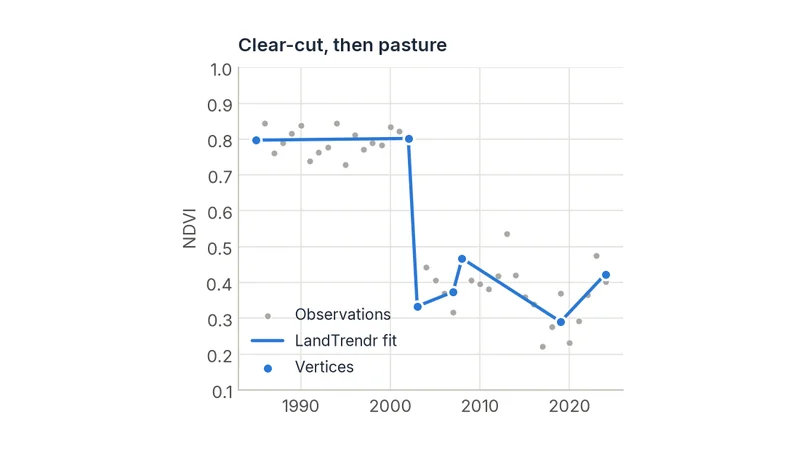
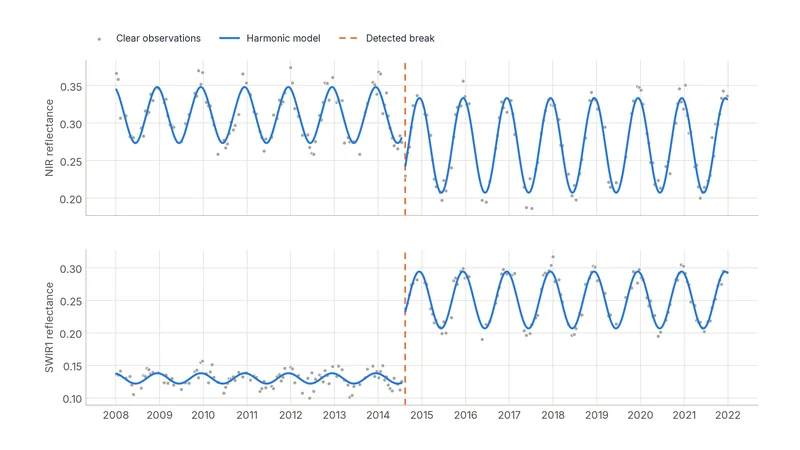
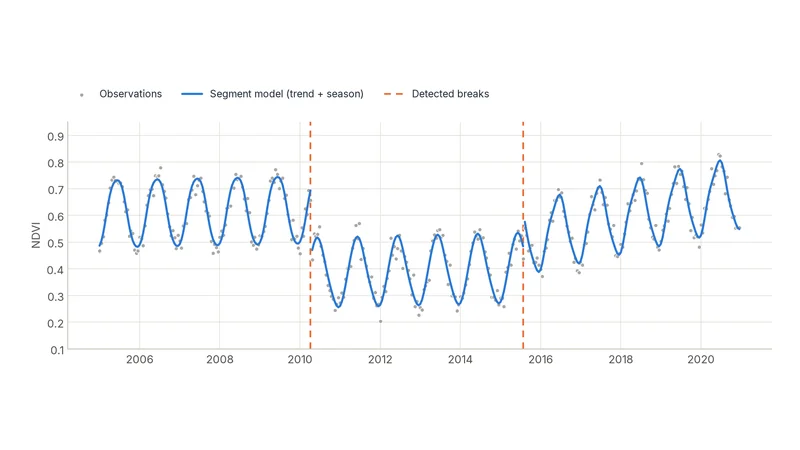
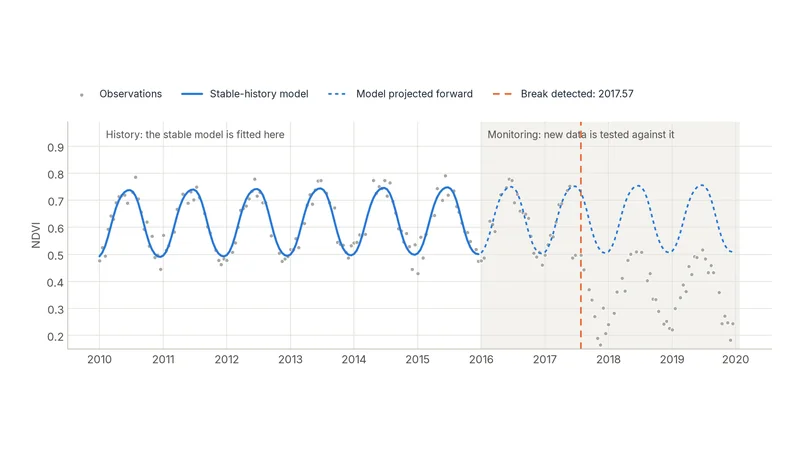
| LandTrendr | CCDC | BFAST Lite / BFAST | BFAST Monitor | |
|---|---|---|---|---|
| Input | 1 index, 1 value per year | Up to 7 bands, every clear observation | 1 index, regular series | 1 index, regular series |
| Models the season? | No (annual values) | Yes (harmonics) | Yes (harmonics) | Yes (harmonics) |
| Detects | Abrupt and gradual change, recovery | Abrupt change, any time of year | Breaks in trend (and season, for BFAST) | The first break after a date |
| Typical use | Forest disturbance history | Land-cover change mapping and classification | Retrospective break analysis | Alerts |
| Speed per pixel | Very fast | Moderate | Moderate | Very fast |
Combine methods
The methods complement each other. A common pattern is Mann-Kendall to find where a region is trending, then LandTrendr or CCDC to find when and how abruptly it changed there. Another is Tmask to clean the data before CCDC. See the User Guide for every workflow.